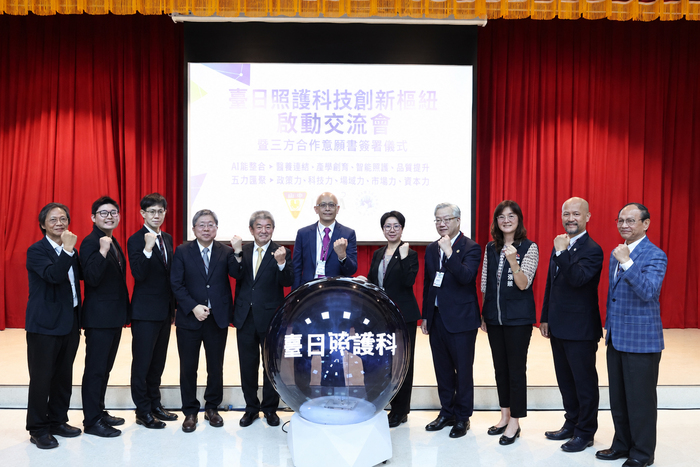

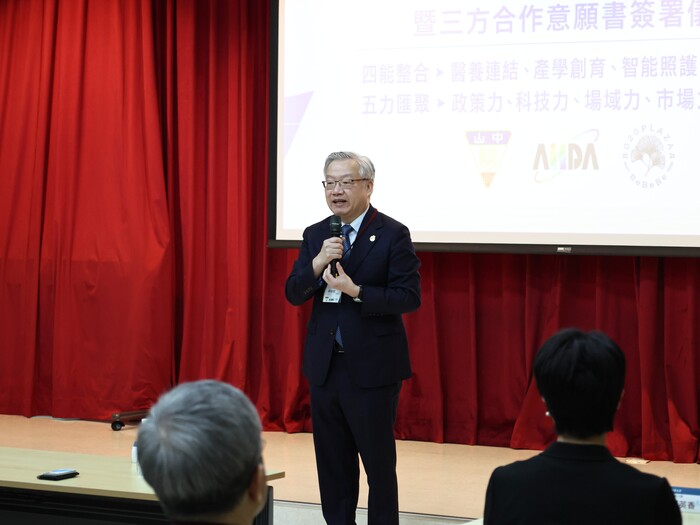
In response to the rapidly aging society, Chung Shan Medical University (CSMU) held the “Taiwan-Japan Care Technology Innovation Hub Launch and Tripartite Letter of Intent Signing Ceremony” on September 21. CSMU joined the Taiwan Association for Senior Industry Innovation and Development (TASIID) and BBB Leisure & Study Co., Ltd. to officially launch a Taiwan-Japan collaboration on care technology. The three parties will focus on the integration of four key capabilities—medical and elderly care R&D, academia-industry innovation and incubation, smart technology, and care quality—while bringing together five driving forces: policy, technology, field application, markets, and capital. Together, they aim to establish a comprehensive support system for the care technology industry.
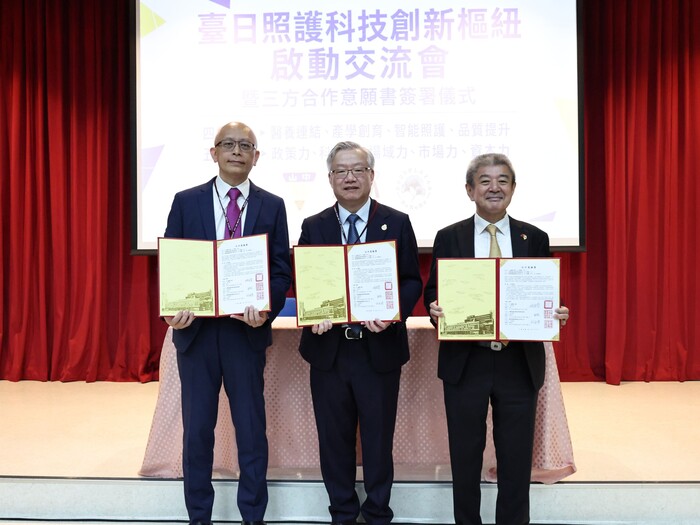
At the ceremony, CSMU President Lin Chun-Che, TASIID Vice Chair Chen Yi-Chien, and BBB Leisure & Study Chairman Lin Chun-Hui signed the letter of intent on behalf of the three parties, marking the launch of collaboration in business incubation, field validation, and Taiwan-Japan industry connections.
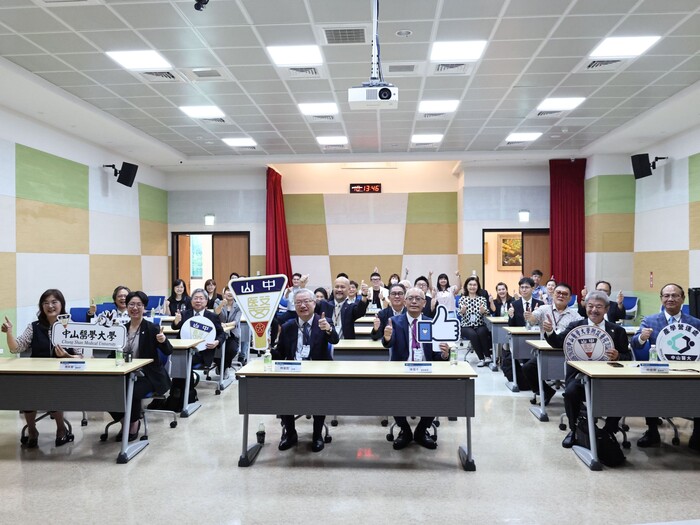
The event brought together representatives from government, academia, healthcare, and the long-term care sectors in Taiwan and Japan, including Chiu Hui-Tzu, Deputy Director-General of the Taichung City Government Health Bureau; Naofumi Iizuka, Director of the Economic Division at the Taipei Office of the Japan-Taiwan Exchange Association; Taro Ando, Taiwan Representative of Sun Group Japan; Chuang Shu-Ting, Deputy Superintendent of Taichung Tzu Chi Hospital; Chang Yu-Shan, Director of Shuanglian Senior Center; Chao Ming-Ming, CEO of Songbaiyuan; Tsai Hui-Chu, CEO of Youran Villa; CSMU Chairperson Chou Ying-Hsiang; Chuang Yao-Yu, Senior Advisor for Industry-Academia Collaboration and former Executive Vice President of the Industrial Technology Research Institute; and CSMU Vice President Sung Hsien-Ying.
CSMU Chairperson Chou Ying-Hsiang noted that Taiwan is facing the dual challenges of population aging and declining birth rates, with many issues requiring cross-sector collaboration. Japan has accumulated extensive experience in elderly care, while Taiwan has strengths in healthcare and technology. She expressed hope that the two sides can combine their respective strengths to develop solutions that address the needs of an aging society.
CSMU President Lin Chun-Che said the signing marks an important step in integrating academia and research, healthcare, industry, long-term care, and capital. CSMU will promote Taiwan-Japan business exchanges, technology transfer, talent development, and international expansion, while establishing a collaborative mechanism spanning R&D, field validation, market adoption, and investment. The goal is to build a care technology innovation platform based in central Taiwan and connected with Japan.
TASIID Vice Chair Chen Yi-Chien said the association has maintained exchanges with Japan since 2017 and has built a membership network of long-term care businesses and institutions across northern, central, and southern Taiwan. The association will serve as a bridge to frontline care needs, helping companies understand the practical needs of older adults, caregivers, and care institutions, while supporting the expansion of mature solutions into the Japanese market.
Lin Chun-Hui, Honorary Chair of TASIID and Chairman of BBB Leisure & Study, said the collaboration will focus on four key areas: dementia prevention, sarcopenia prevention, strengthening independent living capabilities, and enhancing technology-enabled care. The initiative will also connect CareTech companies and industry networks in Taiwan and Japan to facilitate startup exchanges and market collaboration.
Chuang Yao-Yu, CSMU Senior Advisor for Industry-Academia Collaboration, former Executive Vice President of ITRI, and former Director of the Biomedical and Medical Device Research Laboratories, noted that smart technologies and artificial intelligence will play an increasingly important role amid shortages of healthcare and care workers. By collecting high-quality data through smart devices and combining it with AI analysis, more care applications can be developed to improve service efficiency and quality despite limited manpower.
Chiu Hui-Tzu, Deputy Director-General of the Taichung City Government Health Bureau, said that Taichung has more than 510,000 residents aged 65 and above, while its long-term care service coverage has reached 97.8%. She emphasized that long-term care should focus not only on coverage but also on service quality, adding that smart technologies could help reduce the workload of frontline caregivers and respond to growing demand for care services.
Wu Hung-Ming, Director of Industry-Academia Collaboration, said the initiative will also leverage the 2026 Small and Startup Enterprise Incubation Institution Subsidy Program of the Small and Medium Enterprise and Startup Administration, Ministry of Economic Affairs. As the only accelerator in central Taiwan certified as a “healthcare ecosystem-based” accelerator, CSMU will connect incubated companies with clinical resources at its affiliated hospital, helping innovative technologies undergo validation in healthcare and care settings. The initiative will support products in progressing from Proof of Concept (PoC) to Proof of Service (PoS) and Proof of Business (PoB). Beyond verifying technical feasibility, the process will assess the willingness of care facilities to adopt the solutions and their commercial value, helping innovations move from development to real-world application and sustainable growth.
Looking ahead, the three parties will integrate resources from the governments, private investors, and healthcare systems of Taiwan and Japan to establish an investment platform for health and care technology startups. The platform will support promising products through field validation, market entry, and international expansion.